Understanding the water treatment process is about more than knowing the stages. This guide breaks down how each step in the treatment train works together to influence water quality, operational stability, compliance, and long-term plant performance.
Key Takeaways
- A water treatment process is a simple way to show the treatment stages in order.
- The main stages are intake, coagulation, flocculation, clarification, filtration, disinfection, and final treated water output.
- Each stage has a specific purpose, and the technologies used at that stage can affect reliability, compliance, operating cost and final water quality.
- Understanding the sequence is useful, but selecting the right treatment system depends on your raw water quality, required standard and operational requirements.
- A well-chosen treatment process can support more stable operations, lower risk and more dependable water quality outcomes
Water treatment systems are often described step by step, but treatment stages don’t operate in isolation. The performance of one stage affects the stability and efficiency of the stages that follow. Poor upstream control can lead to downstream problems, including unstable filtration performance, higher chemical consumption, increased maintenance requirements, and inconsistent final water quality.
What is the water treatment process?
The water treatment process is the sequence of physical and chemical steps used to convert raw water into water that is fit for its intended application. The exact configuration depends on the source water and the required outcome, but the objective remains the same: remove solids, reduce contaminants, control microorganisms, and deliver reliable water quality.
The World Health Organization recommends a multi-barrier approach to drinking water quality, in which multiple treatment stages work together rather than relying on a single step. That same logic is applied in industrial applications, as well.
Breaking down the stages
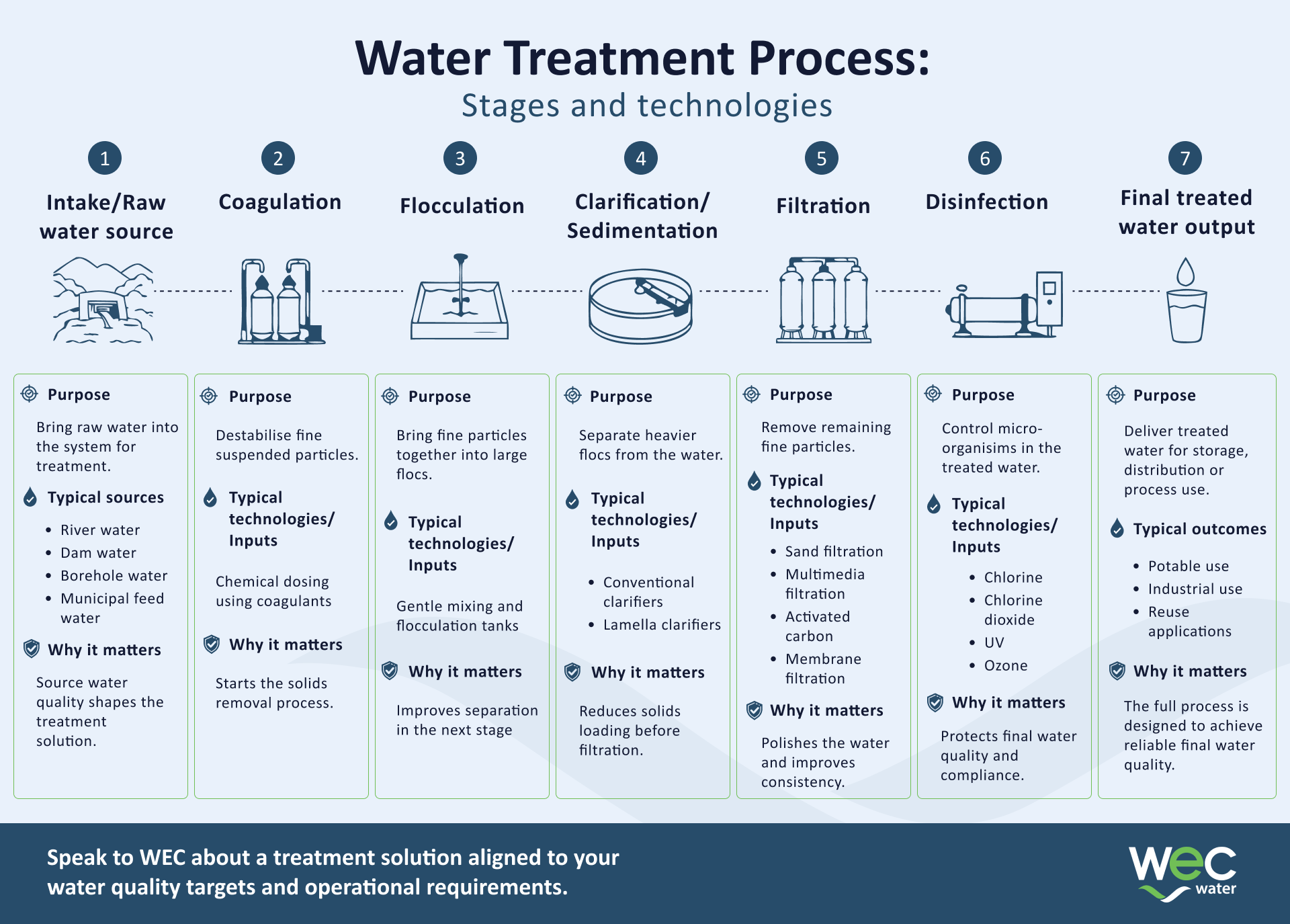
Here’s a flowchart to help you visualise the treatment process and the technologies required. You can follow along as we break each stage down in detail below.
1. Intake or raw water source
Every treatment system starts with a source. This may be river water, dam water, borehole water, municipal feed water, or another raw supply.
This stage shapes the entire solution. Water quality can vary widely depending on the source, and that variability influences chemical demand, solids loading, filtration performance, and disinfection strategy. Before selecting technologies, it is essential to understand what’s in the water and how often it changes.
2. Coagulation
Coagulation is the stage where chemicals are added to destabilise fine suspended particles that would otherwise remain dispersed in the water.
The US EPA overview of drinking water treatment technologies identifies coagulation as a core part of conventional treatment.
Common coagulants include aluminium- and iron-based chemicals. These neutralise the electrical charges that keep tiny particles apart, allowing them to combine and be removed in later stages.
Chemical selection and dosing rates directly affect sludge generation and solids carryover. Downstream filtration performance is also directly affected. Poor coagulation control can increase chemical consumption and overload clarification stages.
3. Flocculation
Flocculation follows coagulation. Chemical agents are added to facilitate flocculation and the water is gently mixed so that destabilised particles can join together into larger clumps, known as flocs.
At this stage, smaller destabilised particles collide and bind together into larger masses that are easier to separate from the water.
Poor floc formation creates unstable settling conditions in clarification and increases solids carryover into filtration. This can shorten filter cycles and increase backwashing frequency. During periods of fluctuating raw conditions, this can lead to inconsistent water quality after treatment.
4. Clarification or sedimentation
Clarification is the process by which the heavier flocs separate from the water, usually by settling out in a clarifier or sedimentation unit.
Clarification design affects more than just solids removal. Technology choice influences plant footprint, sludge handling requirements, civil infrastructure costs, and the solids loading placed on downstream filtration. In constrained industrial or municipal sites, those factors significantly influence both capital cost and long-term operability.
Technologies include conventional sedimentation systems and lamella clarifiers. Our water treatment capability includes pressure and gravity lamella clarification.
5. Filtration
Filtration is the polishing stage. It removes the finer particles that remain after clarification, improving the consistency of the final water quality.
Filtration performance directly impacts daily plant operations. Technology choice affects backwash frequency, membrane fouling rates, cleaning cycles, operator intervention, and recovery efficiency.
Depending on the treatment objective, filtration may use sand filters, multimedia filters, granular activated carbon, ion exchange, or membrane systems.
For applications with more stringent water quality requirements, conventional filtration may be followed by membrane systems, such as ultrafiltration (UF) or reverse osmosis (RO). UF is commonly used to remove very fine suspended solids, bacteria and colloidal material before downstream polishing stages, while RO is used where dissolved salts, minerals, or conductivity need to be reduced to meet process specifications.
Our services include pressure and gravity filtration, ion exchange, and membrane technologies such as ultrafiltration, nanofiltration and reverse osmosis.
6. Disinfection
Disinfection controls microorganisms that remain after physical treatment.
This stage relies on the quality of the stages that precede it. It becomes less effective when upstream stages are unstable. High turbidity or inconsistent filtration performance can reduce disinfection efficiency and increase microbial risk.
Reliable upstream treatment helps reduce disinfectant demand and supports more stable compliance with final water quality standards.
Common options include chlorine, chlorine dioxide, UV and ozone.
7. Storage, distribution, or final treated water output
Once treated, the water is stored or directed to its end use, whether that’s municipal distribution, potable supply, or an industrial process.
At this stage, the effectiveness of the overall treatment train becomes measurable. The objective is consistent treated water quality under real operating conditions, including fluctuations in raw water quality, changing demand profiles, and day-to-day operational pressures.
Our Kasane case study shows how a multi-stage process, including coagulation, flocculation, lamella sedimentation, filtration, and disinfection, was applied in practice to meet defined potable standards.
Why choosing the right technologies matters
Understanding the treatment stages is useful, but selecting the right overall solution requires a broader view.
Technology choice should be guided by raw water quality, target water quality, compliance obligations, operator capability, footprint, maintenance resources and long-term operating priorities. A process that performs well in one application may not be the right fit in another.
Effective process design is about understanding how technologies interact under realistic operating conditions. A treatment train must be able to handle changing raw water quality, maintain stable performance during peak demand periods, and remain practical to operate and maintain over time. Poorly matched technologies can create unnecessary operator burden, excessive maintenance requirements, and recurring compliance instability.
We support our clients and guide them as to which technology would be best in a given situation. We offer water treatment solutions, broader capabilities across water, wastewater and reuse, and sector experience in areas such as food and beverage water treatment.
Get in touch
Understanding the treatment process helps clarify how different technologies affect water quality and long-term plant performance.
The success of a treatment system depends on how well each stage is configured to handle operating conditions and changing water quality challenges.
If you are planning a new system, upgrading existing infrastructure, or reviewing treatment options, speak with our WEC engineers and experts to design a treatment process aligned with your water quality targets and operational requirements.
FAQs:
What is the water treatment process?
The water treatment process is the sequence of physical and chemical treatment stages used to improve raw water quality for municipal, industrial or potable use. Each stage removes specific contaminants or stabilises the water before it moves to the next part of the treatment train.
What are the steps in the water treatment process?
Most conventional water treatment systems include intake, coagulation, flocculation, clarification, filtration, disinfection, and final storage or distribution of treated water. Some applications may also include advanced membrane technologies such as ultrafiltration or reverse osmosis, where tighter water quality control is required.
How do coagulation and flocculation work?
Coagulation uses chemicals to destabilise fine suspended particles that would otherwise remain dispersed in the water. Flocculation is a chemical agent that is added then gently the water is mixed, allowing particles to combine into larger flocs that can be separated more effectively during clarification or filtration.
What technologies are used in water treatment?
Common water treatment technologies include chemical dosing systems, flocculation tanks, clarifiers, sand and multimedia filtration, activated carbon, ion exchange, ultrafiltration, reverse osmosis, and disinfection systems such as chlorine, UV or ozone treatment.